Categories
Uncategorized

Prefiguring inclusive societies: an ability capitalism perspective

I recently had the pleasure of participating in a two-day series of workshops at the EUI in Florence (I was there remotely) on ‘Law & Revolution: Prefiguration v Abolition?‘. Apart from being a fantastically generative couple of days, the workshops were a prompt for thinking more about what an ability capitalism lens can suggest in terms of remedies. Can we prefigure more inclusive societies, or must we abolish the institutions and structures that currently construct oppression?

In the paper I wrote for the workshops, I suggest that we can place prefiguration and more contestatory actions on a continuum by appreciating both through Frerichs’ four-fold ranking of social interactions. Prefigurative actions tend to be those at the micro- and meso-levels of actions and interactions: those small(er) scale actions that seek to construct the world anew in the here and now. Prefigurative politics struggles to scale up.

By contrast, at the macro-level of regimes, we can think of contestatory actions such as revolution and abolition: those movements that seek to reshape (or do away with) the institutions and structures that perpetuate our currently existing conditions of oppression.

However, as I set out in my book, there are feedback loops between the four levels, and of particular relevance here are those meta-level rationalities, or ways of thinking. These are the deep epistemic categories through which we organise our understanding of the world. These, inevitably, take time to change, but the smaller-scale, prefigurative movements can step in here, offering a blue print for what comes next and how things might work. In short, prefigurative movements can set the stage for the embedding of rationalities that can enable contestatory actions to succeed.

So where does ability capitalism come in?

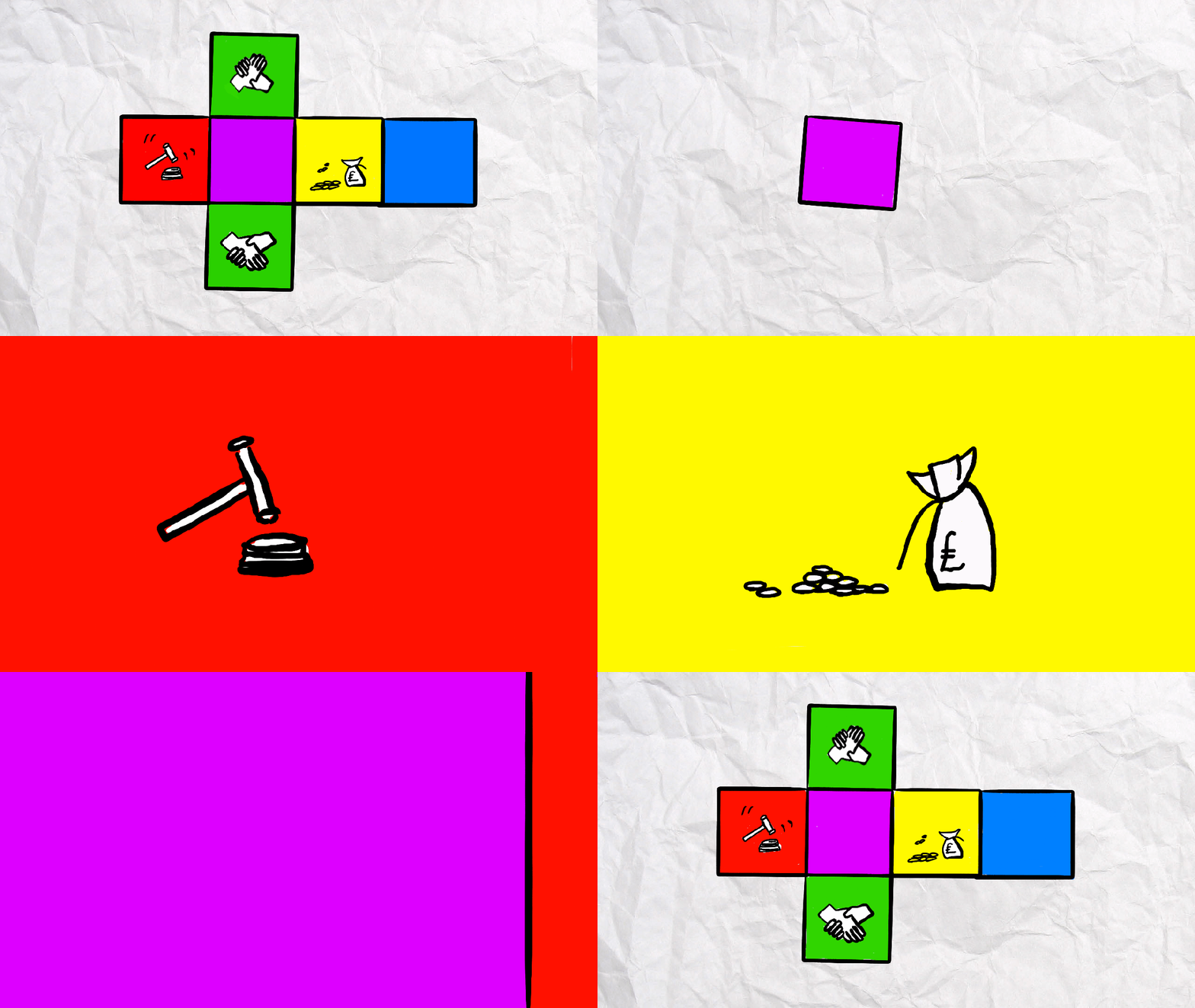
I identify three types of prefiguration that might be relevant: prefigurative methodologies, prefigurative politics, and prefigurative legality. Prefigurative methodologies are those ways of doing research that can create the conditions for us to safely and inclusively interrogate the areas we are seeking to research, as if conditions were otherwise. Here, we might think about visual contracts, or virtual reality, or model making, for example.

Prefigurative politics refers to movements at the local level that seek to construct alternative, preferred ways of doing and thinking. We might think of cooperatives, mutual aid societies, credit and housing unions, and so on. In short, these are groups of people who come together to achieve goals via means that differ from the typical market regimes and rationalities that comprise our current institutional structures. Of relevance here are personal assistance cooperatives, as well as housing and worker cooperatives. Interestingly, while cooperatives can offer alternative structures that might not reproduce ability capitalism to the same extent, as Graby’s research demonstrates, great care must be taken not to dismantle the market-based structures that can offer some protections to disabled people.

Finally, prefigurative legality refers to those practices of playing with, within, or between the rules: taking the existing rules and realising different, preferred outcomes. Examples here are those given by Cohen & Morgan in their paper where they discuss Amelia Thorpe’s book on PARKing Days, or, more relevant for our present purposes, the use of charity law by Disabled People’s Organisations (DPOs). Charity law (in the UK and elsewhere) recognises the ‘relief’ of disability as a charitable objective, entrenching medicalised and individualised models of disability. Yet many DPOs are legally constituted as charities, enabling their access to funding. DPOs, however, offer routes into paid employment for disabled people not despite, but because of their disability, subverting typical labour market outcomes. So, we have an example of playing within the (legal) rules to realise quite different (market) outcomes.

In future posts, I’ll say more about these examples and the possibilities of prefiguration for challenging the (re)production of ability capitalism.
Categories
Ability Capitalism Ability Capitalism

Ability Capitalism

Ability Capitalism, or law’s constitutive role in market constructions of disability, is a new theory that explores how disability is produced under capitalism. I’ve added a separate site page setting out some of the core concepts of the theory, and while I’ll include a brief recap here, I want to explore some of the applications of the theory and my plans to develop it further.

What is Ability Capitalism?

Ability Capitalism unpicks the complex and nuanced ways in which disability has emerged as a core concept or rationality that is central to the effective and efficient function of markets. The proposition that markets disable is not new, and there’s an emerging body of research in the political economy of disability exploring this. What is lacking, so far, is a nuanced account of the constitutive role of law in commodifying and coding assets (Pistor, 2019), and how the tacit and invisible assumptions in these legal technologies set the foundations for market expectations of (and preferences for) workers and consumers with ‘standard’ bodies and minds (Russell, 2001).

As such, Ability Capitalism brings together Law and Political Economy insights with an Economic Sociology of Law lens to understand how the law commodifies assets to unlock their latent value – be this labour, property, or money. These are the three core areas that the theory is currently exploring, speaking to the seemingly intractable disability employment and pay gaps, homeownership and private rentals gaps, and the disability debt gaps and price tag. In short, disabled people* continue to be underrepresented in labour and property markets and overrepresented in debt markets, and despite myriad rights to equality, these gaps persist. Why?

Law’s constitutive role in markets

Most mainstream theories in both law and economics assume that markets are ‘natural’ phenomena; that they emerge spontaneously and self-regulate, structuring social relationships according to their own internal logics. This leads to two propositions in relation to the role of the law. Firstly, that law should generally get out of the way and leave markets as free as possible from intervention or regulation. Secondly, that where market failures and exclusions arise, the law should generally step in ex post, or after the discrimination has occurred, to offer remedies (although there is an anticipatory duty to make reasonable adjustments).

However, far from being ‘natural’ phenomena, markets are in fact specifically legal constructs (Lang, 2017). Bartering, trading, and so on, cannot emerge without some predistribution of legal rights and interests (Somers, 2022). In other words, an allocation of rights to ownership, for example, is necessary before anything can be bought and sold. But this means that, in predistributing rights and interests, the law plays a significant role in shaping market actor preferences. If you own a lot, you are likely to have different interests and motivations upon entering a market than if you own very little.

However, this legal predistribution is typically invisible. Let’s take an example.

Legal Predistribution: an example

Say you want to sell your labour. Labour is commodified (that is, transformed into something that can be bought and sold) by the legal concept of the ‘standard employment relationship’, usually seen in the form of the standard employment contract (Fudge, 2017).

Employment contracts typically set out, among other things, where and when work tasks will be performed, the remuneration offered, and how the contract can be terminated. Employment contracts, however, usually do not overtly specify that the worker can get themselves up and dressed independently, that they can get to the place of work on time and navigate an exclusionary built environment, or that the worker can get through the day without needing rest breaks for medication, etc. In other words, there are myriad unspoken assumptions that make the standard employment contract possible, but which disadvantage those with ‘non-standard’ bodies and minds.

As these assumptions are invisible, they are not typically available to either negotiation or legal challenge. Yet they perpetuate disadvantage, contributing to the disability employment and pay gaps.

Similar examples exist throughout labour, property, and debt markets, and I will be exploring some of these in future blog posts.

So, what does an Ability Capitalism lens propose?

For the example above, an Ability Capitalism lens would suggest that, to fully understand the ways in which the law sets the foundations for market constructions of disability, we need to make visible and tangible the ways in which disadvantage is coded into the system.

In the case of the standard employment relationship, that might entail a detailed mapping of the assumptions and preferences arising from processes of legal predistribution. In short, how, where, when and why do labour market preferences for ‘standard’ workers manifest?

Then, drawing on a legal design methodology such as visual contracts, how can we make these assumptions visible so that they are available to negotiation and challenge?

One upshot of combining a historical materialist account of disability with insights from law’s constitutive role is that enhanced social care provision and support that reduces the costs of the reproduction of disabled labour might offer one pathway to challenge the disability employment gap.

What’s next?

I’ve explored the potential of Ability Capitalism in the context of the labour market here, and am extending this analysis to property and capital/debt markets (aligning with Karl Polanyi’s three fictitious commodities). However, it is likely that there are many more examples of the ways in which law plays a constitutive role in market constructions of disability.

And, once constructed, disability then plays a crucial regulatory role in the management of markets, emerging as a technology of governance not only for those classified as disabled/non-disabled, but acting as a tool to manage supply and demand, market function, and (indirectly), inflation and the wider economy.

For these reasons, while an Ability Capitalism lens suggests that equality rights are necessary, it proposes that they are not sufficient to realise full substantive equality or inclusion. As such, we need combined approaches that include rights, but which also explore decommodification (or, more accurately, recommodification) strategies that address ex ante distributions of rights and interests.

Stay tuned for further explorations.

*I use language throughout that aligns with the British social model of disability; that is, an understanding that people are disabled by inadequate built or social environments rather than any underlying physical, mental, or energy impairment. For more, see UPIAS.

Categories
Maps methodology methods PhD Research Social Sciences Teaching

The Mountains of Metaphor

I’m so excited to be launching this project. I’ve mentioned it a few times (just a few) over past blog posts, but here we are… it’s live! You can visit the site here, and I’ll be posting more about the processes involved and how I’m approaching it here.

Copyright Clare Williams 2021, images reproduced here with the kind permission of tl;dr.legal

This project has been a long time in the making. I first started sketching out what my “journey” might look like in 2019, right after passing my viva and feeling that I could give myself permission to step away from the core content of my research for a bit. It had been a long 8 and a half years. In hindsight, it was worth every step. But there had been moments along the way where I’d sworn blind I wasn’t cut out for this and was going to quit.

Fortunately, for me, I had a wonderful support team of supervisors and mentors who made sure that the nuclear option never happened. But I’m not alone in having moments like this – any long research project has its ups and downs. Sometimes we want to give up. We don’t feel we’re good enough, or can make this lifestyle work.

So, the Mountains of Metaphor project is a way for me to share my story and reach out. Maybe you’ve experienced something similar? Maybe you’re considering a PhD but aren’t sure how to approach it, mentally?

There are some supplementary materials on the site that you can download and play around with – why not try creating your own map of your research journey? Where are you on the map? What’s going on around you? Can you still see your eventual goal?

Why not send us a postcard from where you are?

Categories
Embeddedness Free market Social Sciences

How abstract ideas are “embedded” into everyday interactions…

There seems to be a general consensus at the moment that our ways of doing, talking and thinking are the constructs of “good ideas” in the social sciences over the past few centuries. We are living “the dreams of dead people”, to quote Yuval Noah Hariri. Once these are taken up on a broader level by society, these “good ideas” become taken for granted. We don’t spend our days pondering the rule of law, separation of powers, agency, productivity, and so on. We know these are important and work, as concepts, because… well, they just do. Look around you.

But the seeming invisibility of these “ideas” is a problem. Ignoring the fact that we prioritise concepts agency hides their historical and cultural contingency, and then leaves these unavailable to analysis. How can we challenge neoclassical economic theory that has become “common knowledge” or “just the way things are” when we no longer even notice it?

There have been a few books, blog posts and tweets recently that have spoken to this which are worth mentioning here.

Firstly, James Suzman’s new book. He’s just done an interview about this with GQ magazine, and it’s well worth a read. To oversimplify his argument hugely, he challenges our current notions of productivity in western liberal culture, and specifically puts this in the context of property ownership, heritage, lineage, time and space. In other words, our focus on productvity – often at the expense of other factors in life – is a cultural, social, legal and economic construct. Why do we internalise norms of productivity? Because a few economists 100 years ago thought that the abstract notion might be a good thing for growing the economy (and profits). However, in the process of moving from neoclassical economic theory to mainstream cultural doctrine, it has changed the way we see ourselves as citizens and as consumers.

There’s also a biography of Torsten Veblen by Charles Camic out at the moment, which is a really interesting take on the “outsider” economist. Geoffrey Mead has written a review on the LSE Review of Books Blog here, which offers “an excellent account of how Veblen arrived at his influential contributions to economic theory and paying close attention to how abstract ideas get embedded in institutions and practices”.

Well, yes. They do. And my book (out later this year) is a deep dive into the impact the way we talk about law and economy on how we do and think. Specifically, I look at embeddedness. In the drive to “Build Back Better”, there’s been a lot of talk of “re-embedding” the economy in society. Since responses to the 2008 financial crash started to appear, there have been a lot of statements either that “the economy is embedded in society” or that “society is embedded in the economy”. Start looking out for them – they’ll crop up more than you’d expect. And yet nowhere is there an explanation of what we’re talking about (what is embedded in what) and what we really mean by this.

Image of one large blue sphere with a smaller red sphere attempting to "embed" itself into the blue sphere. This is ultimately impossible because they are separate phenomena
“Nowhere is there a definition: what is embedded in what”. What are we actually talking about? My work shows that talking about law and economy as “embedded in” society is superficially helpful, but actually restricts innovative responses. We are just repeating the mainstream vocabularies and grammars that got us in to this mess in the first place.

But it really is important. My work is about just one example. But if we do want to Build Back Better, we need ways of talking about law, economy and society that recognise, acknowledge and then challenge “common sense” or accepted ways of doing and thinking about the economy. And this starts with those “good ideas” or abstract notions that eventually work their way into the mainstream and become “received wisdom”, invisible, or “just the way things are”.

Matthew Syed wrote a comments piece in the Sunday Times this week about a new drug for obesity, but placing it firmly in the wider context of personal responsibility, agency (as a Weberian ideal), and the atrophying of this that happens when the state gets too involved in individuals’ lives. I think he misses a trick by not recognising that while the agency-structure duality is open for debate, the “structural elements” (the food industry, the farming industry, and the advertising industry) have evolved under the guise of free marketeering far faster than our capabilities as agents to confront these, both on a social level and a biochemical level. Nevertheless, this is a prime example of one of those “common sense”, “received wisdom” ideas (personal responsibility) that is derived from “good ideas” of theorists (agency and the notions of the individual agent of neoclassical economics) that is held up (usually by free market advocates) that we tend to ignore. Yet we ignore it at our peril. The agency-structure debate is as relevant as it ever was, however our grammars and vocabularies to respond to current crises, crashes and catastrophes are those of the mainstream… in other words, the mainstream mental models that got us into this mess in the first place.

So, we need new ways of doing, talking and thinking about the legal and the economic. We need new grammars and vocabularies that challenge these accepted notions. The fact that we are turning more to the social sciences, to our social and institutional heritage to seek answers for how we can respond to the current crashes, crises and catastrophes is something to be celebrated. The social sciences have a huge role to play in our response. We cannot Build Back Better without them, and the founding fathers of sociology still have a lot to teach us, if we’re willing to listen.

Categories
PhD Thesis Visualising ESL

Visualising the PhD journey: once you start looking for metaphors…

A little heads up on a current (soon to be revealed) WIP: I’m visualising the PhD journey using digital paintings, maps and interactive story-telling. It’s an exciting project and I can’t wait to share it when it goes live. This means that I’ve been thinking about metaphors and ways of storytelling. And it turns out that once you start looking for visual metaphors, they turn up everywhere.

My own personal metaphor for undertaking the PhD was pretty mainstream, despite being invaluable. For those who don’t know, I’ve been climbing a mountain whilst doing the PhD. Passing the viva was effectively reaching the summit, but on the way were a whole bunch of added extras, from being caught in an avalanche (loss or illness), so taking shelter in a cave while storms raged (fighting my university for access and not feeling able to go on), to getting stuck in a swamp and totally lost (doubting that my work was valuable, relevant, or particularly insightful).

Whatever was happening in my life at the time, there was a convenient metaphor for it, and one that helped me put my problems into a tangible frame where I could appraise their significance (objectively), figure out a plan, and then refocus on my goals. I think this is why I found the metaphor so helpful, and why it was it one of the keys to me completing the PhD after 8 years of hard slog. Having that mountain in the distance meant that, regardless of what happened along the way, I never lost sight of my goals and was able to appreciate the storms for what they were; temporary blips that would not permanently interrupt my progress.

Sky: Children of the Light

While my forthcoming project is designed, painted and written by me as a visual representation of my metaphorical journey, I stumbled upon a different version of the metaphor… scrolling through the latest games on Apple’s App Store, I came across a game called “Sky: Children of the Light”. Here are some screen grabs from the App Store, mainly so that you get an idea of the beautiful artwork in this game.

The aim of the game is to get to the top of the dangerous and dark mountain (sound familiar?) and this is best achieved by working altruistically and making friendships (also familiar – no one ever finishes a PhD by working alone). The graphics are undeniably beautiful, and the challenges include decoding glyphs and meeting ancestors to gain their knowledge as you go along (also, very relevant for a PhD journey, although less literal when those ancestors are in book form in a library).

The blurb about the game states that “with your trusty candle, you’ll illuminate the world bit by bit, pushing back the darkness and igniting beacons to open doors to new areas”. This might be a little poetic, but is a comforting thought to those of us trying to develop new knowledge that might just make the world a better place, one day.

“You’ll meet dozens of ancestors who will teach you new expressions – like setting off a dazzling fireworks show – or offer items like capes, hairstyles and musical instruments”. While no one offered me a hairstyle throughout the PhD, learning from ancestors, mentors and peers is a central part of the process. Despite the journey being solitary and even lonely at times, the most valuable resources are the people around you – your cheerleaders.

“Although you can play Sky alone, the experience truly comes to life when you connect with friends, family or strangers. Can’t reach a hidden cliff? Signal to a passer-by who has a more powerful cape and perhaps they’ll take your hand and escort you up. The desire to help others is woven throughout the game’s fabric.” There have been many occasions when I’ve benefitted from the generosity of others in my field. Progress doesn’t happen through sheer slog in the library, but from friendships, kindness, and solidarity. And some beautiful metaphorical scenery.

Categories
Research Social Sciences

What does a Pandemic mean for the social sciences?

A few months ago, I had the privilege of chatting with a student of public policy at one of the leading universities in the UK for science and disease. He was telling me about the postgraduate course he was on, and how public policy is a discipline based purely on science. I thought briefly, and then double checked. You don’t study anything resembling a social science at all then? No ethics, no law, no economics, for example? No no, public policy, he assured me, is based solely on scientific evidence.

I shelved my doubts and put any skepticism down to my natural bias as a social scientist and my tendency to argue for the wider understanding and valuing of the social sciences in any scenario.

And then COVID-19 happened. Of course, this is a scientific conundrum, and scientists, chemists, biologists, immunologists, epidemiologists, mathematicians, and the like are working together globally like never before to test, trial, model, and to keep the rest of us as safe as possible.

But then a strange thing happened. A trend appeared in the Covid19-related deaths, which, frustratingly has been inadequately recorded by the official statistics, but which is pretty plain to see on any photograph wall of “victims”. Deaths of those from a BAME, or those from a black or minority ethic background, exceed the numbers expected if these things were to be in proportion to the population. So what is going on?

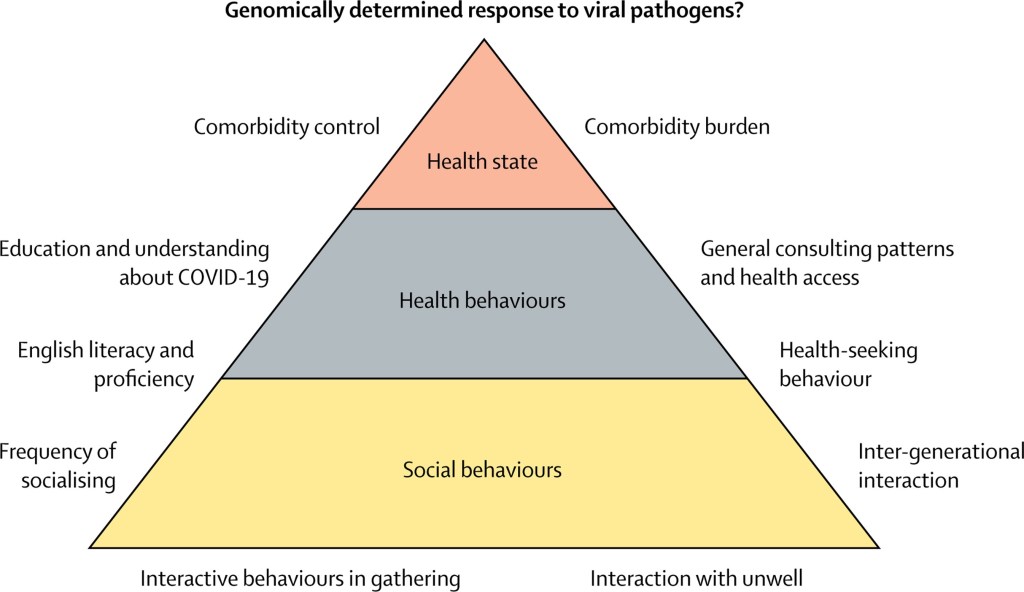
A recent paper in The Lancet identified the issues surrounding ethnicity, stating “Ethnicity is a complex entity composed of genetic make-up, social constructs, cultural identity, and behavioural patterns.2 Ethnic classification systems have limitations but have been used to explore genetic and other population differences. Individuals from different ethnic backgrounds vary in behaviours, comorbidities, immune profiles, and risk of infection, as exemplified by the increased morbidity and mortality in black and minority ethnic (BME) communities in previous pandemics.” This can be represented in the following chart:

From Pareek et al, “Ethnicity and COVID-19: an urgent public health research priority”, available at https://www.thelancet.com/journals/lancet/article/PIIS0140-6736(20)30922-3/fulltext

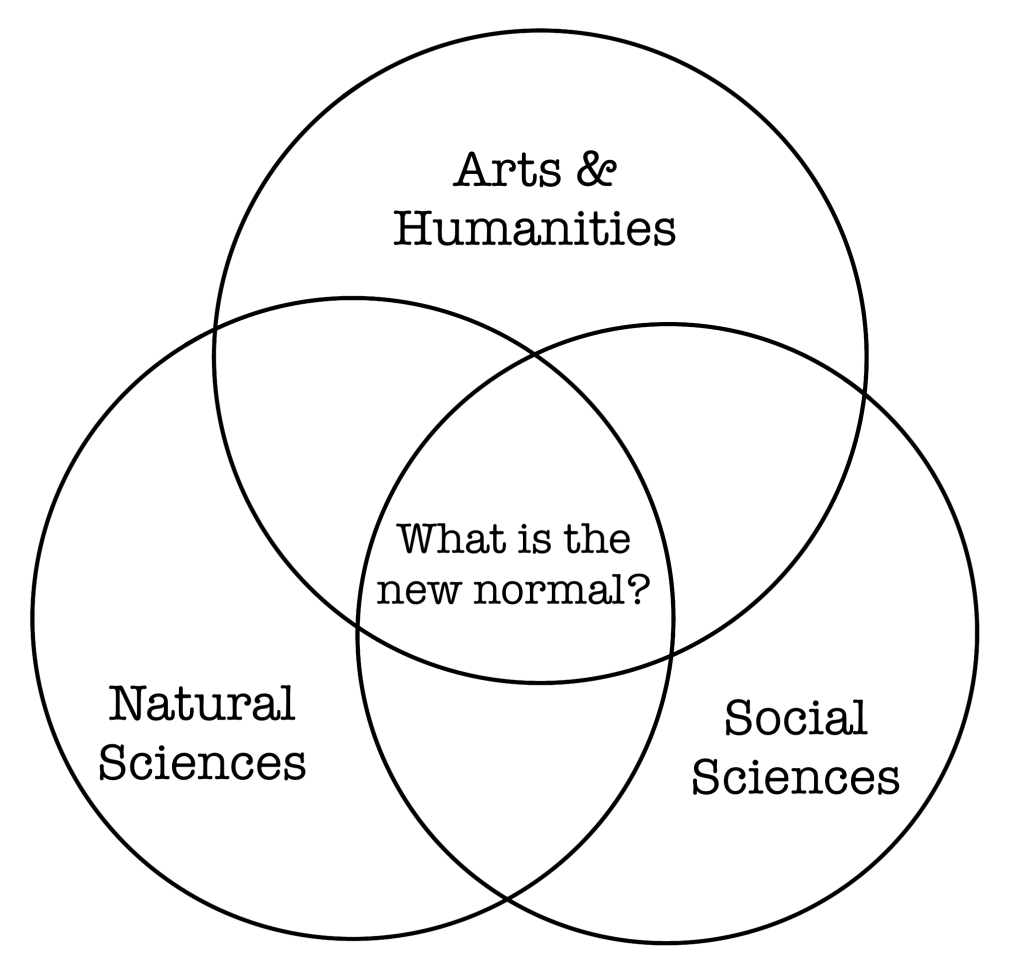
This “complex entity” of “ethnicity” straddles the natural and social sciences as well as the arts and humanities, and there has never before been such a huge need for the disciplines to work together. Could there be any correlation between being a front-line worker and BAME? Is there any truth in the statements that those from a minority ethnic background are more likely to live with extended family in smaller, more cramped housing? Or is the answer down to genetic susceptibility to co-morbidities? The research here is, surprisingly, still in its infancy, although projects like the UNESCO dialogue offer hope that society may be forced to confront the inequalities that COVID-19 has laid bare.

Once again, we are not all in this together. The virus is not a great leveller, and we are not all suffering equally. The statistics bear this out in black and white. But science can only carry us so far down the road investigating this. The rest must be in combination with the insights of lawyers, economics, psychologists, sociologists, anthropologists, and geographers, as well as historians, ethnographers, artists, musicians and – well, as much of society as possible if we really want a representative dialogue. And this means hearing voices that are usually silenced by inequality and minimised by power imbalances.

Interestingly, Germany may be already setting off down this road, enlisting scholars in the Arts and Humanities in that country to help establish a new normal and to ask how society can make sense of the changes. How can we forge meaningful relationships from a “socially-distant” 2 metres? And what might a post-COVID-19 society look like? Sound like? Behave like? Which social values and interests will be prioritised? These are questions that will require the full range of inputs, styles and learning from across the academy.

What is the new normal? And how do we figure out how to get there? This is something that will require the close cooperation of all disciplines.

Despite the fact that we are facing a viral enemy, arguably we have never needed interdisciplinary research more, specifically combining insights from the social sciences, arts and humanities to interpret, process, disseminate and enhance understanding of the work of the natural sciences. COVID-19 has highlighted inequalities that society had previously been able to ignore. The role of the social sciences, arts and humanities in elevating those voices and interests will be critical not only to the successful implementation of vaccines and treatments (community dialogue and involvement is essential for engagement with health services), but for the reconsideration of social priorities and equality more generally.

Categories
economics PhD

“Oh God, the Economy!” (or how a meme can sum up my PhD thesis)

Who doesn’t love a meme? And when a couple of these come along that just happen to sum up your doctoral thesis, it’s both impressive, depressing, and a funny feeling of having come full circle.

Thanks, internet.

Elon Musk, king of many things but also of the art form that is The Meme, was widely panned for his early laid-back response to the pandemic, preferring to worry over the economy instead. And then there was this:

Admittedly, this is open to interpretation, and Musk hasn’t clarified how many layers of sarcasm are at play here but judging by more recent tweets, he seems to mean this literally. The image, of an astronaut on the moon watching the destruction of the planet earth while worrying about the fate of the economy is perhaps a fitting metaphor for some of the narrative around the Covid19 pandemic. Some have suggested that Musk was actually referencing the real role of the economy in human health, and the mutual dependence of the two rather than the “lives versus economy” binary that has defined the pandemic discourse. Alternatively, the image could beg the question of whether we are sacrificing the planet to satisfy the gods of economy. More on this later. In the meantime, the internet responded magnificently:

Humorous, yes. But there are two points to note here that relate to the relationship between economy, society, and the planet.

Memes are metaphors

Firstly, these make great visual metaphors for our preoccupation with the economy at a time when lives are being lost to a virus. James Geary cites metaphors as essential for framing a subject, which in turn defines how we think about something. His book “I is an other” notes that:

“We think metaphorically. Metaphorical thinking is the way we make sense of the world, and every individual metaphor is a specific instance of this imaginative process at work. Metaphors are therefore not confined to spoken or written language.” (Kindle Loc. 219-221)

Perhaps the originator of work into metaphor and its effects on framing and cognition, George Lakoff highlights the importance of metaphor and its role in how we perceive, conceive and understand something that then gets wired into our neural circuitry. See “Don’t Think of an Elephant“, as well as Lakoff & Johnson’s “Metaphors we live by“.

A metaphor is a way of likening one thing to something else. In this case, the pandemic is represented by the destruction of the world, with the distant astronaut concerned over the fate of the economy. Is the implication really that the pandemic is a looming apocalypse? This would probably strike most people as extreme, but the similarities include the fact that we have not faced a global pandemic in living memory, that our way of life or “normal” probably has met the same fate as the meme-planet, and that the fate of the earth and the climate crisis has been unceremoniously bumped down the order of global priorities.

Much of the discussion about our responses to the pandemic seems to have polarised debate into a “lives versus the economy” binary. Of course, the world is not as simple as this. In previous posts I’ve emphasised the need to bring economics back into the social science and reorient it around people, highlighting the fact that without humans interacting, there is no economy. This fact seems to have been largely ignored in the discourse – if people are sick, the economy suffers. If the economy suffers, people will too. They are two sides of the same coin – another metaphor for trying to explain that the economy (itself a metaphor for a collection of human behaviour) benefits when we are fit, healthy, and productive, and vice versa. Pitting the one against the other is, admittedly humorous but erroneous and ultimately unhelpful.

Metaphors frame our thinking

Secondly, how (you ask) does Elon’s meme sum up my PhD thesis? Interpreted literally, it’s wide of the mark. But seen ironically, the meme captures a Polanyian interpretation of the economy-society duality.

We use metaphor to think, and our ways of thinking about the law and the economy are as steeped in metaphor as any area of life; in fact, possibly more so. We attribute human qualities to the economy (it’s “gathering strength”, it’s “taken a tumble”, etc), and neoclassical approaches have tended to prioritise the free market as a self-regulating mechanism that can regulate human behaviour accordingly.

This encapsulates Karl Polanyi’s assertions about the relationship between the economy and society. In more recent debates after the 2008 financial crisis, the question tended to be “is the economy embedded in society, or is society embedded in the economy” (both of these are readings of Polanyi’s thesis, and yes, they are contradictory). The point is, when we use “the economy” as a metaphor to start talking about collections of human behaviour, we can begin to personify these, and start talking about the economy as if it were a living, breathing thing. While we might think that “economy” should function for the benefit of society, there are those who argue that society now functions for the benefit of the economy. Some commentators have argued that the metaphorical aspirations of the economy have taken over the narrative, to the extent that society works to serve economic goals. We strive to increase GDP, growth, productivity, and so on.

And so, Elon’s meme neatly sums up the subordination of society, and the earth, to economic goals. At the same time, it hopefully asks us to reconsider the relationship between the economy and society, economy and the planet, and how we can move forwards in a mutually beneficial manner.

Categories
3D interactive methodology Visualising ESL

ESL in 3D (the first steps)

What if we could visualise frames and concepts in 3D and move around to see the impacts of those frames?

With the help of a little 3D modelling software called Blender, this is possible.

How can we visualse a frame – literally and metaphorically?

This is the very first step towards making a 3D version of my thesis. There is a lot more to learn, and a lot of work to be done, but the possibilities here are extremely exciting. Currently, this is compressed and uploaded as a GIF, meaning that the sequence is shorter, the frame rate is reduced and there’s quite a lot of noise. But you get the idea… what if we can visualise the frames, concepts and theories that we talk about in the social sciences? How could the visual assist in exploring how we do, talk, and think about law and economics?

Categories
acoustic jurisprudence economics Embeddedness methodology methods Research Visualising ESL

Diving in to an ESL frame…

This mini animation, with sound, asks what the reintegration of the economic, legal and social might look like and sound like.

This is relevant for each and every interaction that occurs – there are always legal and economic aspects to every interaction, but we tend to forget that talking about the legal and economic in isolation from the social is a metaphor, or fiction.

How might we think about integrating legal, economic and social phenomena conceptually?

How could frames or lenses like ESL help us to remember the social basis for any legal or economic aspects of interactions?

Categories
Development economics Research

What if … we all worked together?

In other words, “why science does not have all the answers… and why it needs to work with the social scienes for maximum impact”.

This post starts from the saying that a scientist can tell you how to clone a human being, but a social scientist can tell you why this might not be a good idea… or then how to regulate the technology and maximise social benefit if you’re determined to go ahead.

Similarly, I was watching BBC’s “Pandemic” on BBC4 with Dr Hannah Fry, which aired last week. This asked how vulnerable we might be to a viral infection that had decided to turn into a global pandemic. They took a group of mathematicians and modelled the infection rates of the virus across a small town in the south of England. The results were, frankly, worrying. A pandemic is coming. The questions relate to how prepared we are.

The approaches were entirely scientific, and consisted of mathematicians and virologists wondering how social interactions could spread a virus. It did occur to me that if they had included a social scientist on the panel, someone could have pointed out that scale, depth and nature of social interactions have actually been the subject of social science research for decades.

The team used smart phone GPS tracking to analyse social interactions and deduce the likelihood of infection from these.

The results of the Pandemic experiment revealed the existence of some so-called super-spreaders of infection. These were generally high-profile individuals in the community – people who ran local businesses or who spent time in cafes or busy hubs of social interaction. This led to the suggestion that vaccinations could be targeted at super-spreaders for maximum impact. This was certainly an impressive result of the experiment and hugely important if we are to respond effectively to a super-virulent strain of flu, for example (the experiment assumed possible infection from 20 metres away).

But, instead of focusing solely on science, what could the results achieve if we combined insights from the social sciences to change behaviour as well as immunity?

As we know, you can present people with all the facts in the world, and they will fail to change their behaviour accordingly. Vaccinations, the climate emergency, and so many other examples show that presenting people with “the cold, hard facts” will change nothing. There’s an side point to be mentioned here about the devaluing of information through the spread of “fake news”, but since the 1970s psychologists have demonstrated that “reasonable-seeming people can be completely irrational”. For a review of the main studies in this area and why reason and confirmation bias could actually be helpful from a social perspective, see this post in The New Yorker. Applying this to cognitive bias that can be dangerous for the belief-holder, the Gormans have analysed how we can tackle these mistaken thoughts.

On the other hand, research has shown that “nudges” and insights from social science can have as much, if not more impact than financial incentives. The Behavioural Insights Team, founded on Sunstein and Thaler’s “Nudge”, published in 2008, looks at opportunities to shift the context in which people make decisions, hopefully pushing them towards “the correct” choice. In the case of improving our diets, or reducing knife crime, this is obviously a good thing. But what does this mean for epidemiology, virology, and pandemic response?

What could we achieve if we combined the insights of the natural and social sciences? The BBC Pandemic experiment into how viruses infect a community are insightful. But only when they are combined with the insights of the social sciences to actually translate this into real human behavioural changes that could change lives.

For example, if we want people to wash their hands for 20 seconds using soap, telling them about how they are reducing abstract infection rates will have little impact. “Nudges” on the other hand, like installing timers next to taps, singing happy birthday twice, or better still stopping water-saving taps that cut off water after 3 seconds, will have far greater impact. Other nudges that could encourage people to wash their hands are reminders that “everyone else does”, and countdowns near taps that tick red until 20 seconds are up – potentially showing on a smart screen how many bacteria are left on the subjects’ hands… these are just suggestions. But imagine what we could achieve if we combined science and social science insights. We would be unstoppable!